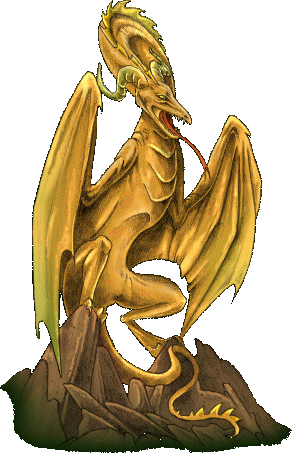
Basic Dragon InformationDragon TypesThis section will deal with the different types of dragons. Dragon types are general styles of dragons, usually set apart by the number of limbs or the method of flight. For more specific breeds of dragons, check the Dragon Species section.
Amphiptere / Amphithere / Amphitere
The Amphiptere, also spelled as Amphithere or Amphitere, has been found in European heraldry.
They were particularly feared in Europe, so any person who bore an amphiptere across their
shield or as part of their coat of arms would be regarded as
fearsome.1
An amphiptere is literally a flying serpent, equipped with a pair of wings. They possess no other limbs. In many depictions, the wings are feathered, like a bird's wing, instead of webbed like a bat's wing. Dragons of Fame: Famous Amphipteres: Quetzalcoatl
Anthropomorphic Dragon (Anthro)
An anthropomorphic dragon is usually a combination human and dragon parts. The anthropomorphic
dragon is usually bipedal and have usable forearms. Sometimes, these dragon types have hands with
fingers, but more often they are depicted with talons or claws on their forearms.
Dragon Beast
The term "dragon beast" has been used on this website in cases of dragon or serpent hybrids that
fit dragon classification but do not fit the general types or species associated with many
dragons.
A dragon beast may have the head or tail of a dragon, or may possess the ability to morph into a dragon or serpent hybrid. For more information on dragon classification, please read the Why is it a dragon? article. Dragons of Fame: Famous Dragon Beasts: Chimera / Chimaera Drake
In traditional history and myth, there are two variations of Drake. In the Balkan states, the
Gypsy community's Drake resembles a dragon (Western Dragon) but has a
humanoid body without wings. This Drake, however, is an individual dragon and not a dragon
type.2
The second traditional drake can be found in Sweden and other European countries. The drake is related to the Lindorm, an enormous serpent that moves by slithering, despite its limbs.2 In modern history, legend, and heraldry, the drake is a dragon with four limbs, much like a lizard, although usually far larger in size than the average lizard. A particularly potent example of a drake in the natural world is the Komodo Dragon, a large species of minotaur lizard in Indonesia. These particular creatures have low-slung bodies, much like crocodiles and alligators, with their bellies lying across the ground. The term drake has been used mostly in Europe and North America, although this types has a particular shape fitting to other dragon species beyond that region. Consider the Taniwha, a powerful creature to the Maori people of New Zealand. Taniwha often appear in the form of gigantic tuatara, which are lizards indigenous to New Zealand.
Drake picture provided by Dee Dreslough.
Eastern Dragon
Given the span of history and span of geography that the Eastern Dragon traverses, it is perhaps
unfair to attempt to summarize all variations under a particular heading. Throughout history,
the shape and temperament of Eastern Dragons changed, leaving many variations under the same name,
and many species of Eastern Dragons as well.
For a brief generalization, the modern Eastern Dragon that has been inherited has the body of a snake, belly of a frog, scales of a carp, head of a camel, horns of a giant stag, the eyes of a hare, ears like a bull, a neck like an iguana, paws like a tigers, and claws like an eagle. Eastern dragons are described with an angelic authority and beauty and possess incredible wisdom.14 In the Chinese Zodiac, the year of the dragon is considered a very auspicious year, and those that are born in that calendar year are blessed with a long life full of health.14 This is because throughout history, the Chinese Lung (dragon) has been considered an important symbol of greatness, power, benevolence, and gifts.14 The Chinese Lung is a divine, generative creature and will overcome any obstacle for success. Later, the Chinese Emperor adopted the Lung as a symbol of imperial law and the Emperor himself, imbuing the symbol with new authority and more power than before.14 In China, the phrase "Lung Tik Chuan Ren" means "Descendents of the Dragon," and sometimes is used to describe the people of China and at other times particular lineages.14 In Taoism, the Taoist Chuang Tzu (399-295 BC) taught of the mysterious powers of the dragon. The teaching explored and reflected the resolution of conflict and balance of opposites, and so through Taoist thought and expression, the Eastern Dragon became a symbol of unity.14 Temples built for Eastern Dragons or with Eastern Dragons as guardians are placed near the sea or rivers, because in many places across the East, dragons inhabit and rule the waters of the earth. Eastern Dragons can create clouds full of fertilizing rains for the earth, which associates them with storms, particularly thunder and lightning, and also makes the Eastern Dragon a symbol of the unity of the two waters: the waters of the earth (lakes, rivers, the sea, etc.) and the waters of heaven (the rains).14 The royal families of Japan trace their ancestry back over a hundred generations to Princess Fruitful Jewel, also known as Rich Jewel,14 or Toyo-tama. She was a daughter of the Dragon King that married a mortal man and bore him a son before returning to the Palace in the Sea. Dragons of the East have benevolent properties and often imbued with particularly potent powers, especially power over the rains and other natural forces. Because of the complexities of the Eastern dragons, it is broken into various species and a larger article. Further Reading: Eastern Dragons, Dragon Species: Ch'i-lung, Chiao, Fuku-Riu, Hai-Riyo, Han-Riu, Horned Dragon, Ka-Riu, Lung, P'an-lung, P'eng-niao, and Ying-Lung.
Fairy / Fairie / Faerie / Fae Dragon
Fairy dragons are perhaps the smallest of all dragons, since they are associated with insects
and fae people in folklore. Fairy dragons would be much like Western-Style dragons, except
far smaller (roughly the size of a large butterfly) and with insect-style wings. In many
cases, fairy dragons are depicted with butterfly wings, light and beautiful.
Of course, while many fairy dragons have the same shape as a Western-style dragon, with forelimbs and hind limbs and a pair of wings, there have been other instances where fairy dragons have only had hind limbs, like wyverns, or have had many legs, like a bumble-bee. Other common traits of the fairy dragon include association with fairies and other similar magical folk, insect traits like antennas, and an affinity for flowers.
Great Serpent
The Great Serpent type is different from the Wurm
because a great serpent need not be of spectacular size, shape, or location. A great serpent may
indeed be a large specimen or a snake with horns or antlers, but in many cased it will simply be
a snake imbued with important wisdom or powers, usually power over human life, fertility, or
natural phenomenon.
A great serpent may be considered an ancestor or totem animal of a particular group or family, or it may be the great guardian of a local well, watering hole, or sacred field. A serpent that is revered and respected or feared and killed, regardless of size, may be considered a great serpent.
Hydra
A Hydra, like the Ouroboros, can take the initial characteristics of
any of the other dragon types. What makes the hydra a separate type is the additional components
of the monster, usually multiple heads.8 Some hydras have additional
tails or wings.
Hydra picture provided by Dee Dreslough.
Lindorm / Lindworm
Lindorms are long, thick serpents with two forelimbs with a scaled body and horse-shaped
head. Marco Polo wrote about these dragons on his travels.9
"They have two forelegs near the head, but for foot nothing but a claw like the claw of a hawk or that of a lion. The head is very big, and the eyes are bigger than a great loaf of bread. The mouth is large enough to swallow a man whole, and is garnished with great [pointed] teeth." -- Marco Polo3
Ouroboros / Uroboros
Ouroboros has appeared in many cultures, including the Aztecs and the Egyptians. The ouroboros
is a dragon, usually a wurm or a western dragon,
that continuously devours its own tail.10 They are a symbol of
eternity and the cyclical nature of the universe.10
Read more about Ouroboros.
Sea Serpent
These creatures live in the waters. They can live in fresh or salt water. They are depicted as
long and serpentlike without limbs but with long, steering tails. Other types include finned as
well as serpents with webbed limbs. Some are depicted with wings, but they tend to be useless in
the water.
Fear of these creatures was rampant during the 1400s, when colonialism from Europe began to spread. Many people believe that sailors feared "falling off of the world because man the earth was flat." However, the fear of the sea serpents was much more prominent. If there was ever a place with uncharted waters, the map would be marked "HERE BE DRAGONS."6 Many speculate that the sightings of these creatures were simply larger squids, pieces of kelp, and even dinosaurs. Many believe that the Basilosaurus could have been mistaken as a Sea Serpent.4
Sea serpent picture provided by Dee Dreslough.
Serpent-Waist
Despite not being a classical dragon or serpent type, this particular type of being exists in
many mythologies and as many different Dragon
Species. Much like the term Dragon Beast, this
type has been coined for the Circle of the Dragon.
The serpent-waist is a dragon that has a human, or humanoid, body with a serpent's body from the waist down. Many serpent-waist beings have the ability to morph into either fully human or fully serpent form, and sometimes the particular being has the ability to do both.
Western Dragon / Occidental Dragon
(Occidental meaning a characteristic of European countries.)
The Western Dragon is perhaps one of the best-known fabulous monsters. The Western Dragon has
an enormous, scale-covered body, similar to that of a crocodile, with membranous wings like that
of a bat5 and a barbed, serpentine
tail.6 Western Dragons have four thick, powerful legs and powerful
claws with the talons of an eagle.6
These dragons have large, wedge-shaped heads, like a big lizard or a crocodile, with either a crest or horns (or antlers).5 Their mouths are filled with huge fangs, and Western Dragons could exhale noxious fumes, or even fire.5 Western dragon by Donna Quinn Western Dragons may be massive, independent beings, a part of a predatory community with a ruler, or even the servant of a sorcerer or other powerful person.5 Ancient to colonial cartography marked unexplored and unmapped regions of the earth with the words, "HERE BE DRAGONS."6
Wurm / Worm / Orm / Vurm / Wyrm
Wurms have thick, serpentine bodies with a head shaped either like a horse or a crocodile.
Many wurms are described as having horns.12 Wurms have dangerously
large fangs and bright, wide eyes.12
In comparison to Western Dragons, reports of wurms and their legends have attributed them far fewer supernatural powers, although they do have the ability to exhale noxious fumes or even fire.12 They can be found in swamps, lakes, or even wells.12 The wurm also appears in European lore under the name of Guivre.7 Another, perhaps comical version of the wurm can be found under the name Wivre, which was quite malicious. Luckily, the Wivre would only attack a person wearing clothing, so anyone under assault by the vicious creature would simply have to disrobe.11 Wyvern
The Wyvern is a dragon with the body of a serpent, the head of a dragon (shaped like a
crocodile), wings of a bat, two legs, and a long, barbed tail.13
Seen as particularly vicious throughout Europe, many legends of wyverns involved them destroying villages or traveling parties.11 The many slaying myths of wyverns perhaps explains why these dragons are particularly popular among heraldic crests and coats of arms. Dragon graphics without citation are all provided by Amber Dragon's Lair.
Footnotes
For more information on references and footnotes, please see the bibliography. Privacy Policy | Disclaimer | Contact | Home
© Kylie 'drago' McCormick |
![]() |