Myths
Myth is an immensely complex subject, and often it is difficult to define except in opposition to other terms. Perhaps an oversimplification: mythology is traditional knowledge associated with ritual or social customs from a particular social group. In this way, myth is related to religious or spiritual elements, and a mythic story contains supernatural beings, deities, and spiritual powers.
Traditional knowledge must be passed down by previous generations, not invented by the current one. [1] Therefore, if myth is accepted as traditional knowledge, it is an inherited set of ideas; and as traditional knowledge is not limited to any format, myth can apply to musical elements, rituals, chants, aphorism, epics, short stories, blessings, charms, spells, and so on.
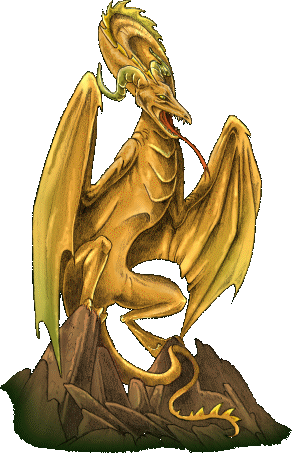
The important distinction for myth is, generally speaking, the connection of spirituality and religion. A mythic dragon will appear alongside of deities, heroes, or monsters, and the myth will likely relate to a religious element, such as an icon, story, or blessing.
Legends
Legends have a strong connection to events in history. [5] Characters in legend are sometimes historical people, such as rulers or warriors, wrestling with supernatural and superhuman entities. Sometimes historical characters are imbued with mythic or magical powers.
The distinction between a legend and a myth can become fuzzy, since many legends derived supernatural or spiritual elements from mythology. Legends tend to relate stories about the world or even the lineage of particular members of society instead of stories about the spiritual or religious ideas.
Since a legend is tied to events in history, dragons in legend are sometimes considered 'historical dragons.' For example, in France, the dragon Tarasque is linked to a particular event in French history; as a result, the Tarasque is considered a 'historical' dragon.
Folklore
'Folklore includes all the human knowledge, customs, and beliefs that have been passed down through the oral tradition.' [6]
Obviously, the definition for folklore is a wider net than myth or legend. In the nineteenth century, W. J. Thomas coined the term 'folklore' for the term 'popular antiquities,' usually used to refer to the unrecorded traditions of a given group. [3] By this understanding, folklore also encapsulates superstitions, customs, proverbs, riddles, [4] and pseudoscientific lore. [2]
However, a more commonplace understanding of the term is that folklore is 'stories told by folks,' which generally indicates a level of popularity and informality, even entertainment.
Depending on the type of folklore in question, a dragon from folklore may be associated with omens, explanation of weather, or even a humorous event.
Footnotes
For more information on footnotes and references, please see the bibliography.