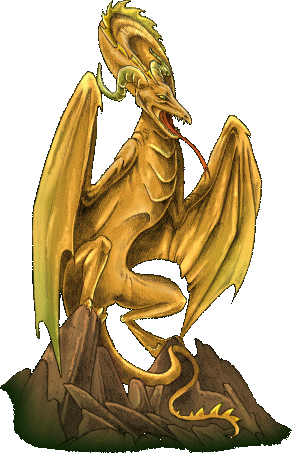
Quick Naga Terms and Alternative Names and Spellings
The following are alternative names or spelling variations for Nagas.
- Bhogavati
- Bhogini
- Bhujagas
- Jaja
- Nagunis
- Nagnis
- Naia
- Naja
- Naje
- Pannagas
- Uragas
The following are terms sometimes used in regards to the Naga or their kingdoms:
- Nagini Devis - wives of the Naga chiefs [36]
- Nagaraja - Naga Kings
- Nagakanya ('snake maiden') - female Naga [20]
- Nagini - female Naga [20]
- Naga Knayas - daughters of the Buddhist Naga Naga Knaya [6]
Introduction
Naga is the Sanskrit word for 'snake,' [34] and it is also the name of a semi-divine race of supernatural beings. Depending on the source, the Nagas are regarded as demons, [2] deities, [3] a race of serpents, [6] supernatural serpent beings, [8] water spirits, [9] guardians, [6] personified forces of nature, [9] demigods, [15] or divine water-serpents. [34]
Nagas, regarded as demon-serpents, answer to one or more ruling gods, such as Anata Sesha, [30] Yama the King of the Dead, [31] and Shiva. [32] Nagaraja rule domains ranging in size from a single field to an entire country. Nagas are expert navigators and began colonies on distant coasts. [35]
Nagas are heavily featured in both the Hindu and Buddhist mythology of India. [5] Some possess a divine pearl of knowledge. [4]
Sculpted Naga figures guard doorways to sacred places. [4] Often Nagas are engraved in pillars. [33] Stone slabs inscribed with their images are placed around special trees to assure human fertility. [4]
Serpent Mythology and the Naga
The snake is unlike other animals, in that it has a peculiar shape. [10] Without limbs, it glides across the ground, [10] and in Southeast Asia, some of the serpents actually glide through the air. Serpents have unblinking eyes, deadly venom, a forked tongue, and a sloughing process of its skin. [10] These mysterious attributes of the serpent invite lore and legend, which in turn imbues mythic attributes of the Naga.
For example, the serpent is believed to have chakshuhsravas, or 'hearing by sight.' This is because there is no visible ear on the serpent. [12] A serpent will stick out its tongue, giving an impression that serpents could feed on the wind. [12] Thus, the serpent has many nicknames, include 'licker,' 'double-tongue,' and 'wind-eater.' [12]
One of the most prominent serpents in Southeast Asia is the Cobra, which, beyond its venom, also has the added element of a hood. [18] The Cobra's hood has curious spectacle markings, called 'serpent a lunettes' in French and 'brilalang' in Dutch. [18]
The Naga of Indian mythology particularly are beyond semi-divine serpents; they are the cobra raised up to the rank of a divine being. [18]
An annual rite, Sarpabali, has a dual purpose: honoring serpents and warding them away. [11] The Sarpabali takes place in the rainy season, when the rains cause many snakes out of their underground hiding places and therefore are of the most danger to humans. [11] The Sarpabali are specifically for the Nagas.
Physical Description
In most of Southeast Asia, Nagas are usually described as part-human, part snake. [6] In some areas, the description is more succinct. In Indonesia and Thailand, the Naga is a five-headed dragon that guards temples. [8] In West Malaysia, Nagas are a species of multi-headed marine dragons that grow to terrible sizes. [8]
Nagas have jewels either in their hoods, necks, [17] or heads. [7] This jewel is more than just a decoration. The jewel forms in throat of the Nagas, and it emits a light brighter than diamond. [17] Should a Naga need to discover anything in the dark, it need only disgorge the jewel then swallow it again when it is ready. [17] Though coveted, misfortune would befall anyone who killed a Naga to obtain the jewel. It is possible to obtain it by throwing dust upon it when it is out of the Naga's mouth. [17]
Some descriptions claim that the Nagas have jewel-studded faces or scales. [1] The Naga have three distinct forms as follows:
- Human: fully human body with serpents crowning the head or growing from the neck [4]
- Split: upper body of a human with the lower region in snake form [7]
- Serpent: as a common serpent, usually with multiple heads. [4,7]
These forms are considered separate from the ability to transform into other living creatures, such as humans or lions, because the Naga's three forms above are a part of its own nature. Depictions of the Naga may favor one of the three forms described above, depending on the time period, region, and religion.
In its human form, the Naga is characterized by the polycephalous serpent-hood. [24] A Naga may have a crown of serpents or serpents around its neck, [7] but usually the human figure is hooded. [24]
In the split form, a Naga has a human body above the waist with a serpent body below the waist. [24] The torso and above have human characteristics, including arms with five-fingered hands. [4] Below the waist, serpent anatomy presents a strong tail, sometimes dubbing this form the 'mermaid form.'
In its serpent form, a Naga will have multiple heads. [24] The number varies but is uneven; the most common counts are three, five, or seven. Sometimes the serpent form presents with a human face. [32]
While a Naga may take the form of a human, they don't belong to the human world at all. They belong to Nagaloka, the mysterious realm of the serpent. [8]
Nagini were known for their beauty. [20] Stories describe their fair hips and their faces as resembling the full moon. [20] Nagini are clever and are always well dressed, and when they appear as nymphs or women, mortal men often fall in love with them. [6]
Male Naga have slate-colored skin and cold, serpentine eyes. [3] Apparently, the male Naga's visage is responsible for the evil nightmares about snakes and snake people. [3]
Naga Types, Tribes, and Classes
Nagas are dragons of the earth, waters, sky, and heavens. [4] Another division defines Nagas as divine snakes portioned into three groups: Nagas of the earth, the sky, and the heavens. [11]
Earth, or Hidden, Nagas guard treasures deep within the earth, like precious metals or jewels. [4] Water Nagas reside in Palaces of Gold, Ruby, or Emerald at the bottoms of springs, lakes, and rivers. [4] Divine, or Sky, Nagas form clouds and produce rain. Depending on the mood of the Naga, the rain could be for the crops or it could be a flood. [4] Heavenly Nagas guard the temples of the gods. [4]
When the four classes are limited to three, the Earth/Hidden Nagas are combined with the Water Nagas.
Another classification for the Nagas is by tribe. The tribes are the Nagas that dwell in the sea and the Nagas that dwell in the mountains. [20] The Nagas of the mountain tribe, sometimes called the Nagas of the Mountains and Trees, have a very rare occurrence in legend. Nagas of the sea tribe, or those that lived in bodies of water, are far more common. [20]
In Buddhist tradition, the two tribes were tending towards a horrific war until Buddha himself intervened. [20]
The Birth of the Nagas
Prajapati had two fair and exceedingly beautiful daughters, Kadru and Vinata, and they both married the sage Kasyapa. [25] Kasyapa granted each of them a boon of their choosing. [26]
Kadru chose to become the mother of one thousand Nagas, all of equal splendor. Vinata, on the other hand, asked for two sons more powerful than the thousand children of her sister. [26] In due time, she brought forth one thousand egg, and her sister brought forth two eggs. [26] Kadru ('the Tawny One') is the personification of the earth; therefore, the earth is the mother of the Naga. [14]
After five hundred years, all one thousand Naga children hatched. It took another five hundred years for Vinata to meet her child, the Garuda. [26]
The Descendants of the Naga
Many dynasties and groups traced their ancestries back to mythological or legendary figures. Throughout the Far East, many families and tribes had a Naga ancestress. [24]
In Ancient India, many royal houses identify at least one Naga or Nagini ancestor. [21] Specific examples include the following:
- Dynasty of Kashmir, eighth century AD, descended from the Naga Karkota. [21, 22]
- Members of the Ruling Class in the Principality of Bhadarvih cited the serpent-king Vasuki as part of their lineage. [22]
- Naga Pundarika founded the line of Rajas of Chuita (or Chhota) Nagpur. [22]
- Dynasty of Pallavas descended from the son of the Chola King nad a female serpent-demon. [23]
An historical dynasty of kings in India were known as the Naga-Dwipa. [7]
Naga as Water Deities
The Nagas of the Earth lived in beautiful underwater palaces. [1] Some describe this location as an aquatic underworld; the Nagas personify terrestrial waters. [5] Naga are also associated with weather, specifically rain, so in times of drought, people plead to the Naga for rain. [7]
As Rain Deities, they are guardians of both water and wealth. [6] They live in palaces underwater in Bhagavati or Nagaloka. [8] Nagas enjoy the ocean, and sometimes the ocean is called the Abode of the Naga. [19] Often they are benevolent and wise towards humans that pay due respect. [34]
In popular Indian belief, the Nagas are fertility bearers, likely because of the association with rain. [2] Each Naga would bestow fertility and wealth, or disaster and flood, on areas of the world with which she or he is individually associated, be it a field, a place of worship, or an entire country. [5]
The gifts of the Naga are correlated strongly with appropriate worship and gifts. When ignored, slighted, or displeased by humans, the Nagas can dish out disaster or present a stingy gift. [5] The Nagas are easily moved to anger, so it is important to propitiate the Naga because their connection with their power over the element of water. [9]
Naga as Underground Deities
The great underground caverns and tunnels of Southeast Asia are attributed to the travels of the Naga, who would travel underground and occasionally surface for sunlight and air. [3] They live in Bhogavati, the Underground Capital of the Naga, a glittering city full of music and flowers. [4]
As minor deities, the purpose of the Nagas was to populate the Patala, the underworld. [6] Yama, the King of the Dead, rules Patala, so the Naga answer to Yama. [31] It was often their duty to guard shrines. [33]
Since the Naga race combined the title of demigod with the serpent aspect, they have a duo-claim to riches and the possession of great wealth. [15]
Enemies of the Naga
While the Naga are quite powerful, they have several enemies, including the Garuda and the snake charmer.
Should a Naga leave his or her home, post, or position, she or he was in danger of an attack from their only natural enemy, the Garuda bird. [4] The Garuda are giant bird-like creatures and enjoy eating their mortal enemies, the Naga. [7] As avowed enemies, the Garuda bird will pursue Nagas to release the earth's waters in a time of drought. [8]
Garuda and Naga are cousin races, so hereditary enmity also exists between them, [28] and while the Naga race started with one thousand members, the Garuda started with only one, but eventually an entire tribe of Garuda existed as a threat to the Naga. [29]
Despite the Garuda's fearsome nature as the scourge of Nagas, they are not afforded the same respect.
'Even a great man is not worshipped, as long as he has not caused some calamity: men worship the Nagas, but not the Garuda, the slayer of Nagas.'
-- Indian Proverb [10]
Snake charmers are devastating to Nagas. As opponents, they could be cruel and dangerous because they used a combination of magic spells and drugs to exercise irresistible power over the Nagas. [29]
Naga Most Poisonous
Nagas have deadly venom, but they also carry the elixir of life and immortality. [7] They have the gift of medical knowledge to heal poison. The Naga's bite is so poisonous it is described as 'setting fire' or 'fiery.' [13]
The destructive nature of poison resembles that of fire. This is why poisonous serpents have a high degree of tejas, (Sanskrit for 'heat' or 'fire) a magical energy ascribed to living creatures. [13]
Nagas only harm mortals when they are mistreated, so many superstitions exist to evade the wrath of a local Naga. [7] This is because so deadly is the Naga's venom that a Naga's breath or stare could case harm or kill. [13]
Naga of the Priceless Gifts
The Naga were guardians of more than just previous metals and jewels. [15] Priceless objects, even magical objects, often fell under their protection. [15] Consider the following gifts either given by the Naga or sought from the Naga:
- The Daughter of the River Nairanjana, a Nagini, brought the Bodhisattva a jeweled throne aftter his prolonged fast. [16]
- Nagaraja (Naga King) presented a Brahmin guest with divine garments, ornaments, and a jewel that grants all wishes. [16]
- Naga Vasunemi bestowed a wonderful lute used to capture elephants onto King Udayana in thanks for Udayana redeeming him from a snake charmer. [16]
- Others have tried to win treasures from the Naga, such as 'Beryl-beauty,' a matchless sword that endows its owner with invincibility and kingship over the fairies. [16]
Other priceless gifts of the Naga include the Life-Restoring Jewel of Ulupi, the infallible lasso, and the Naga-power-granting elixir. [16] In some cases, the gifts were temporary, for as soon as those gifts touched the ground (the earth, the home of the Naga), they would disappear and return to the Naga-world, Nagaloka. [16]
Naga in Buddhist Lore
When the Buddha achieved enlightenment, the Nagaraja Mucilinda used his cobra hood to shield the Buddha from the elements, symbolizing the Naga's powers at the service of the Buddha. [5]
In Buddhist mythology, the Naga are devout worshippers of the Buddha, [27] sometimes the guardians of sacred texts. Two Nagarajas, Nanda and Upananda, gave Guatama (the Buddha's mortal form) his first bath. [6] The Buddha's alms bowl was a gift from the Nagas. [6]
Since some perceptions of the Nagas show them as demon-serpents, there are many stories of a Naga transitioning from a demon-spirit to a devout worshipper of the Buddha. [27] The image of a Naga, as a guardian, represents life force. These images are often found at the portals of Buddhist shrines. [6]
Footnotes
- Gibson 157
- Lurker 243
- Allardice 156
- Nigg [Dragons] 35
- Leeming 277
- Turner & Coulter 332
- Turner & Coulter 333
- Rose [Dragons] 261
- Vogel 3
- Vogel 7
- Vogel 11
- Vogel 13
- Vogel 15
- Vogel 20
- Vogel 21
- Vogel 22
- Vogel 25
- Vogel 27
- Vogel 32
- Vogel 33
- Vogel 34
- Vogel 35
- Vogel 36
- Vogel 37
- Vogel 49
- Vogel 50
- Vogel 93
- Vogel 132
- Vogel 133
- Littleton 361
- Katz 13
- Katz 41
- Katz 42
- Airey 186
- Howey 47
- Howey 49
For more information on footnotes and references, please see the bibliography.