Symbolism of the Color Red
Red has a rich, visual spectrum, so it has a complex and intricate symbolic meaning. [4] Red symbolizes everything from passion, love, and sex to blood, wounds, death, and fertility. It can even represent anger, aggression, danger, warning, and protection.
Red is the color of blood and one of the primary colors of fire. [2] Jung believed that this is why red is linked to surging, tearing emotions like anger and love. [7] Other associations include the sun, masculinity, passion, energy, and war. [1] The connection with life and warmth derive from red's blood and fire, [2] while its association with war and death come from red's connection to spilled blood, menstruation, and the blood of the placenta after giving birth. [4,7]
In Paleolithic times, red ochre was mined and ground into powder. Anthropologists believe that people imbued this powder with life-giving powers. [2]
To the Celtics, red symbolized death and the afterlife. [6] The ancient Anglo-Saxons saw red as a protective color that could be used to ward off evil. [2] Warriors covered their weapons with red paint to endow them with magical powers, and red paint and markings afford trees and animals protection. [2]
Some Aboriginal groups in Australia utilized red as a protective color. [2] For other Australian Aboriginal peoples, red symbolizes the land and earth. [6]
In China, red is regarded as an auspicious color [3] because red symbolizes love and fertility. [2] Traditional wedding gowns and veils in China are red. [3] Red eggs are offered to a couple when a child is born. [2] Red is often used in festivals because it represents good luck and celebration. [5,6] Among the five elements, red is associated with the element of Fire and the direction of South. [3] The poetical expression of 'the mark of the vermillion pencil' refers to documents written with red ink by the Emperor. [3]
Other societies associate red with love and fertility. A practice that still remains in Greece, Albania, and Armenia is that of the flammeum, a veil that brides wrap around themselves as a symbol of fertility and protection. [2] This practice can be traced back to the times of Ancient Rome, although some sources report that the flammeum actually was colored an orange-yellow, the color of a candle flame. [2]
In Ancient Egypt, red symbolized the destructive god Set. [2] The Ancient Egyptians used an expression roughly translated as 'making red' to mean murdering someone, and an evil act or plot would be called 'red affairs.' [2] Scribes would use a special red ink when writing words of warning or ill-omen. [2] Similarly, in the Hebrew tradition, red symbolized both the sin and the sacrifice for the sin. [6]
In Western Europe, red indicates or highlights danger. [2] Red also relates anger and aggression, from its association with Mars, the Roman god of War. [2] Modern western usage of red also includes high energy, high speed, [2] low-levels of fuel, and high levels of danger ('red alert').
For the Apache red symbolized victory and success, and it was also the color of the East. [6]
In India, red symbolizes purity, [6] but also sexual passion. [2] In South Africa, red is the color of mourning. [6]
In Feng Shui, red is a color of the element Fire, and it is of the active Yang aspect. It promotes money and good luck and symbolizes respect and vitality. [6]
Modern psychology has found that red stimulates brain wave activity and the heart rate. In some cases, it can even increase blood pressure. [6] Modern politics associates red with Communism. [6]

Summary of Symbolism of the Color Red
Red has a strong symbolic nature owing to its natural manifestation in blood and fire. Depending on the culture and time period, red may represent anger, aggression, high speed, danger, love, purity, joy, celebration, fertility, warmth, rebirth, death, wounds, or protection.
Red Dragons

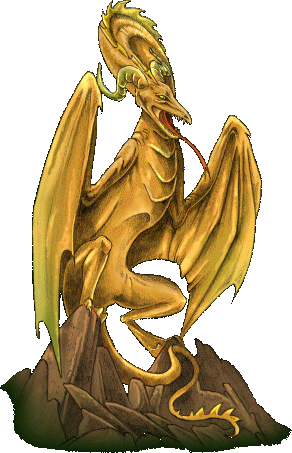
Red dragons are notoriously passionate with a short fuse, tending towards ill-tempered. A red dragon is imbued with considerable prowess in battle. As a guardian, the red dragon is formidable.
Red Eastern dragons symbolized autumn and the west. They cause storms when they battle in the sky.
Dragons of Fame: Smaug, Stollenwurm, the Red Dragon of Wales
All of the dragon graphics on this page were created by Donna Quinn.
Footnotes
- Stevens [Ariadne's Clue] 148
- O'Connell and Airey 115
- Walters 143
- Lanse 6
- Roberts [Chinese] 16
- Visual Color Symbolism Chart by Culture
- Cirlot 53
For more information on footnotes and references, please see the bibliography.