Symbolism of the Color Black
Black is the absence of color, the negative of white. [5] For this reason, black is the color of primordial void, that which existed before the light. [1] Black possesses a mysterious sense of extinction, and it is considered the color of the night, where the unknown is manifest, [5] but black also represents the germinal state, the beginning sure to grow. [1]
The claim that black is universally associated with death, evil, and sickness seems at first, [1] but another look reveals that black has many other associations, such as fertility [6] and newly fertilized lands. [3]
In some parts of the Arab world, black is considered unlucky, [2] but black is also a symbol of power and authority, an emblem of the Caliphate, the first system of government established in Islam. [2]
As a color that seems indifferent, black encapsulates the mark of humility and respectability. [5]
In Ancient Egypt, black is the color of resurrection and eternal life, [2] associated with the mother goddess and fertility, especially in conjunction with red, or blood. [2]
In China, black represents the passive element Yin. Its opposite element, Yang, is bright yellow. [2] Though black is considered a color for young boys, [9] it remains a color of darkness and isn't usually worn as a primary color. [7] In the four primary directions, black is the color of the Dark Warrior, [8] depicted as a tortoise with an intertwined serpent. [4] The Dark Warrior symbolized the north direction, which, unlike the other directions, was never honored or worshipped. People feared it for being the home of the destructive ocean god. [4] The Dark Warrior's element is water, and in Wu Xing, the Five Elements of China, black is associated with the element water. [8]
To the Apache of North America, black symbolizes the West, where the sun sets. [9] Throughout parts of Western Europe, black symbolizes periods of mourning, funerals, and Halloween. [9]
In Feng Shui, black is associated with the element water and the passive yin. Black represents money or income, career, emotional protection, power, stability, and bruises. [9]
In Jungian psychology, black represents the shadow aspect of the unconscious psyche, [1] and in other schools of psychology, black has been linked with self-confidence, strength, and power. [9]
Summary of Symbolism of the Color Black
Black is associated with the darkness, the unknown, the invisible. The fear inspired by these connections may be the reason that black became a symbolic color of power and authority. Black is associated with the night and the setting sun. Black is connected with both death and rebirth. Fertility and the mother goddess, also connected with death and rebirth, intertwine with the color black.
Wearing a black garment might be an indication of position or authority, or it may be a sign of mourning, loss, or even illness.
Because black symbolizes the primordial void before creation, it appears in each person as the shadow personality in Jungian psychology. While the word 'shadow' might indicate negativity, the shadow is not necessarily a negative aspect of the psyche. Much like the physical body's shadow, the shadow of the psyche is present in each conscious person, apparent only in contrast to the conscious mind. The germinal state of creation, too, exists within each person as part of the shadow aspect, from which new synthesis and new creations often arise spontaneously.
The variety of symbolism for the color black is layered. This explains why black is also perceived to be a chaotic color; it represents the shadow, the unknown, and the unpredictable as well as the cyclical processes of life, death, and rebirth, including fertility. Since fertility of the land, and fertility of human being, remains elusive, the chaotic and unpredictable nature of it coordinates with the other associations of black.
Black Dragons

It is said that a black animal incarnates the absolute of their species, which is why many black animals are chosen for ceremonial sacrifice. [5] Consider, then, the black dragon as the absolute of its species.
In Western Europe, black dragons represent incarnated evil, stealing for their hoards and devouring for their meat. Any nocturnal creature with the additional camouflage of black complexion would undoubtedly make it far more dangerous to humans, who cannot see well at night. All the more so for a ferocious dragon.
In China, black dragons cause lightning storms when they fight one another in the sky.
A black dragon would have numerous advantages in the physical world, such as disappearing into a cave or being able to hide in shadow. A black dragon, then, would represent the lurking shadow of the psyche; an immensely powerful and creative creature, although equally destructive, that can remain unseen until ready to make its move.
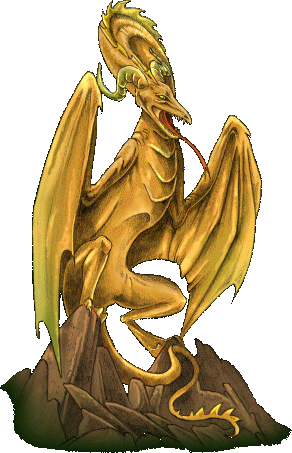
All of the dragon graphics on this page were created by Donna Quinn.
Footnotes
- Stevens [Ariadne's Clue] 147
- O'Connell and Airey 115
- Cirlot 53
- Christie 82
- Lanse 5
- Lanse 6
- Roberts [Chinese] 17
- Roberts [Chinese] 25
- Visual Color Symbolism Chart by Culture
For more information on footnotes and references, please see the bibliography.