Basic Information
Alternative names: Kumbaba, Khumbaba, [13] Huwawa (Sumerian), [3] Hubaba, Hum-ba, Humhum, [13] Humbaba (Assyrian) [7]
Type/Species: Draconic Hybrid
Slayers: Gilgamesh and Enkidu
Origin: Sumerian Mythology, Akkadian Mythology, Babylonian Mythology, The Epic of Gilgamesh, Gilgamesh and Huwawa
About Humbaba
Humbaba was an ancient dragon, with reference and images of him dating back to 2000 BC. [3] In Mesopotamian mythology, Humbaba resisted in the cedar forest in a far away land never visited by humans. [6] Enlil, the great deity, appointed Humbaba as the Guardian of the Forest. [3] Other accounts claim that the gods assigned the fearsome Humbaba the forest as his domain. [6] He was the monster and lord of the Mountains of Cedars (Lebanons), which was sometimes called the Cedar Forest of the Amanus. [13]
Given his epithets and legendary prowess, Humbaba may have originally been a nature deity. [11] Historically, the Elamites worshiped an earth god named Humba or Hubaba, [13] who became Humbaba to the Sumerians as a dragon and the adversary of Gilgamesh. [11]
Humbaba's utterance was fire and his breath was death. [3] He was a demon, or a giant, who assumed the shape of a dragon that spat fire. [13] His voice alone spread fear, forcing all who heard it to cower and shiver. [6] Other descriptions claimed that his breath was like hurricane and his voice, a storm. [13]
The Slaying of Humbaba
The mythical hero Giglamesh, among his many exploits, faced the terrifying guardian of the forest, Humbaba. The Sumerian tale Gilgamesh and Huwawa retells the battle. [1]
The cause of the battle varies greatly, but whatever the reason, Gilgamesh became determined to battle Humbaba. [7] Enkidu, his companion and friend, didn't want to fight the dragon and protested, [3] but nothing deterred Gilgamesh. [6] In one version, Gilgamesh explained that, should he fail, his named would be forever remembered as the man who died at the hands of the guardian Humbaba. [3]
In the Old Babylonian Version of the Epic of Gilgamesh, Gilgamesh claims:
As for mankind, numbered are their days;
Whatever they achieve is but the wind! [...]
Should I fall, I shall have made me a name:
'Gilgamesh' - they will say - against fierce Huwawa
Has fallen!' Long after
My offspring has been born in my house.
-- Epic of Gilgamesh [8]
Other variations attributed different reasons for Gilgamesh's incursion into the forest. In one variation, Enkidu dreamt that he was hurled into the underworld, [13] and Gilgamesh sought guidance from the sun deity Shamash, who gave Gilgamesh and Enkidu a promise of protection and [6] instructed him to overcome Humbaba. [13] In another, Gilgamesh wanted to cut down the sacred cedars to win glory and to build a gate for the temple of the deity Enlil in Nippur. [6]
Enkidu, Gilgamesh's companion warrior, agreed to be the guide, as per his renown for familiarity with not only the forest but also with the tricks of Humbaba. [3] Thus, Enkidu and Gilgamesh took a long journey [12] lasting from the new moon to the full moon, then three days more, [3] which was roughly seventeen days and nights. During this time, Gilgamesh had several ominous dreams, [3] all manifestations of Humbaba's power and position. [2]
There, in the Cedar Forest of Enlil, they met the gigantic guardian Humbaba. [2] The dragon greeted the two men scornfully, taunting them. He asserted that he would bite through their necks and leave their bodies to be devoured by birds of prey. [4]
In the Sumerian versions, Gilgamesh successfully tricked Humbaba and removed the guardian's seven auras, diminishing his power. [6]
In the later Babylonian variations, Gilgamesh struck down enormous trees and exploited them to capture Humbaba. [2]
Other versions recount a furious battle, accompanied by terrible storms and earthquakes, nearly breaking the hero's nerve, but with Enkidu's encouragement, Gilgamesh bested the guardian. [4]
All versions come to the same result: Humbaba pleaded for mercy from Gilgamesh. [6] The hero considered granting a reprieve, but Enkidu wouldn't have it. [4] Thus, Gilgamesh (or, sometimes, Enkidu) [6] decapitated Humbaba. [4]
Enkidu and Gilgamesh regretted this deed later. [4] Not only was Humbaba appointed as the Guardian of the Forest, [4] he had connections to other deities, such as Tammuz and Inanna. [13] Thus, their treatment of the dragon earned them the curse of Enlil, [2] though some versions claim their punishment came from the sacrilege of cutting down the sacred trees Humbaba guarded. [6] His death was atoned by the gods themselves.
Physical Description
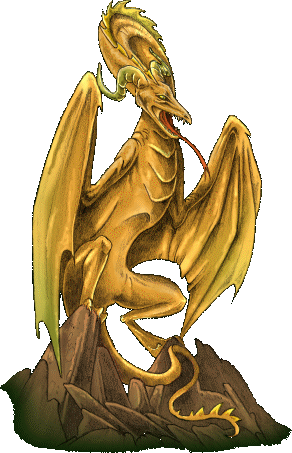
Humbaba is variously described as a monstrous humanoid with animal features, [12] a wicked demon, and [13] a giant [11] that took the form of a fire-breathing dragon. [13] More specific descriptions claim Humbaba had a vast, humanoid body [11] covered with scaled plates. [12] His legs were as a lions, and his talons are vicious as a vulture's. Atop his head he had the horns of a bull, and his long tail had a serpent's head at its end. [12]
Quick Facts
- Enlil, the great deity, appointed Humbaba as the Guardian of the Forest. [3]
- He was the monster and lord of the Mountains of Cedars (Lebanons). [13]
- His utterance was fire and his breath was death. [3]
- He may have originally been a nature deity. [11]
- His voice alone spread fear, forcing all who heard it to cower and shake. [6]
- He was a demon, or a giant, who assumed the shape of a dragon that spat fire. [13]
- The mythic hero Giglamesh and his warrior-companion Enkidu sought a battle with Humbaba to destroy him, [6] or be forever remembered as those who died trying to kill Humbaba. [3]
- Humbaba was decapitated. [4]
- References and images of Humbaba date back to 2000 BC. [3]
Term Reference
Footnotes
- Kramer 14
- Leeming 190
- Littleton 122
- Littleton 124
- Littleton 126
- National Geographic [Essential] 46
- Pritchard 49
- Pritchard 50
- Pritchard 54
- Pritchard 55
- Rose [Dragons] 180
- Rose [Dragons] 181
- Turner 270
For more information on footnotes and references, please see the bibliography.