General Terminology and Background
There are some important terms used in heraldry that I will also use on this site. I won't be reviewing them all, only the necessary ones for explanation.
- Augmentation: An addition to a coat of arms, usually granted by a ruler or the like [1]
- Dexter: While this part of the 'shield' is on the viewer's left side, it is considered the right side of the shield. [2]
- Ensigned: This term means 'placed above'. [2]
- Passant: This describes the creature's position on the shield. It is walking towards dexter with one fore leg raised. [3]
- Segreant: Also known as rampant, this describes the creature's position on the shield. It stands on its hind foot, with the two forelimbs raised up, as if rearing, and with its third leg lifted as well. [3]
- Sejant: The word for 'sitting'. [2]
- Sinister: While this side of the 'shield' is on the viewer's right side, it is considered the left side of the shield. [3]
- Statant: This describes the creature's position on the shield. The creature faces dexter with all legs on the ground. [3]
Heraldry began in the Middle Ages of Europe. During battles, most knights wore armor that covered their bodies, and, while it served to protect them, it also served to hide their identity. To thwart this, the noble families created designs to wear upon their shields to distinguish each other in battle. [5]
In some cases, heraldic crests and shields were altered to award people. For instance, when Sir Francis Drake became the first English man to circle the globe, Queen Elizabeth modified his family's coat of arms. [6] Occasionally, stories (especially legendary ones) would be reproduced on a person's coat of arms to recognize a great feat or adventure of a famous family member. [1]
Wyverns

Figure 1. Wyvern in statant position.
Wyverns are the most common of the draconic heraldic symbols. They are seen almost as commonly as birds, and they are numerous in design. Since most wyverns were depicted as evil dragons in bestiaries, which were widely circulated at the time of the adoption of coats of arms, the fact that so many families adopted them as their symbol is not yet fully understood. [1] However, the wyvern is most notably show as a creature of valor and protection, and, as most dragons in the past, also believed to have great eyesight. [10] In another light, the wyvern is also a symbol of vengeance or may have been acquired threw a family member's slaying of a dragon. [10]
Figure 1 shows a wyvern in statant position as a crest. The wyvern was, most probably, believed to be a symbol of power and strength, which was important in battle. However, very little about wyvern crests and their symbolism have been recorded.
The crest, however, does represent dragonkind as it was believed in those times. Scales, a forked tong, a spiked back, and a whip-like tail make this creature quite formidable.
Hydras

Figure 2. Statant, seven-headed hydra.
Hydras are far less common in crests than the other dragons present in heraldry. The hydra, however, is said to be used on a crest only when a family (or town, or the like) has defeated a very powerful enemy. [4] This may be due to Hercules' defeat of the Lerean Hydra in Greek mythology.
All hydras have at least two heads, but most have either five or seven heads.
Figure 2 shows a statant, seven-headed hydra, perhaps one of the more common shapes the hydra takes in a coat of arms. The creature comes with four talons, rarely five.
Hydras normally stand alone as the only creature on the coat of arms, but they are usually sighted with other decorations and such about them.
Drakes
Drakes are perhaps the rarest of the dragon types found on heraldic crests. The fire-drake, which is referred to in Beowulf, is usually defined as a Western dragon rather than a drake as it is known today.
In Figure 3, however, the crest might just be that: a fire-drake. Lacking wings, the dragon is not a Western dragon, so it could be that fire-drake, at least in this instance, does refer to what we today know as a 'drake'.

Figure 3. Drake.
Amphipteres
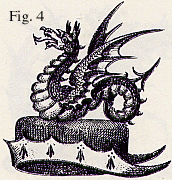
Figure 4. Amphiptere statant.
While there are some amphiptere in crests, they are rarely very large and usually are not the only creature in the crest. Most are seen at top poles, wrapped around spears, or balanced upon spears.
Figure 4 shows an amphiptere facing dexter statant. The symbolism for an amphiptere is unknown, but the symbolism for its misnomer is. The 'winged snake' is usually worn by someone who swiftly deals justice. [9]
It has also been rumored, although with little confirmation, that this creature is found on the coats of arms of those who went to Ireland to 'fight the serpents' there, also called the Draconis Extinctors.
Basilisks and Cockatrices
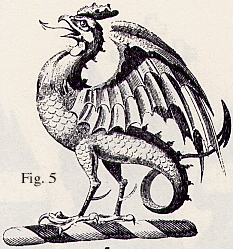
Figure 5. Basilisk statant.
Basilisks Both of these creatures are quite similar in shape and thus in heraldry. Cockatrices were greatly feared of in the fifteenth century, such that a rooster was put on trial for laying an egg, thus possibly creating a cockatrice. [7]
Baskilisks and cockatrices were both known for their deadly nature, namely their deadly stare and their venom. [7] It is safe to assume, therefore, that similar symbolism would be found in heraldry. Therefore, those who chose a baskilisk or a cockatrice as a symbol would probably wish to represent themselves as deadly warriors.
Figure 5 shows a baskilisk facing dexter statant. The creature is a baskilisk, as revealed by its rooster-shaped head and draconic-body.

Figure 6. Western dragon passant.
Western Dragons

Figure 7. Western dragon sejant.
While many viewed dragons as a symbol of the Devil, the Western dragon, four-legged and winged, is a very common symbol on crests. This can be explained by history, for Uther Pendragon, the father of legendary King Arthur, had the symbol of the dragon on his crest. [7]
Keen sight, power, and fearsomeness are usually connected to dragons. [8] Treasure is also thought of when Western dragons are imagined. Thus, dragons obviously symbolized powerful, wealthy people who guarded their wealth keenly. [8]
Figure 6 shows a Western dragon facing dexter in passant position, while Figure 7 shows a Western dragon sejant facing dexter.
Dragons were quite common in heraldry, only second to the wyvern. Some of these have been given to those who have slain a dragon. For instance, Sir Moris Berkeley's coat of arms was changed after he slew the Bistern Dragon.
Other

Figure 10. Western dragon impaled by sword.
Slain Dragons were not just chosen to stand alone on crests, they were often there to accompany other things. In most cases, these other objects are dwarfed by the dragon on the crest. However, especially in cases of augmentation and alteration, dragons were used as symbols of stories.
Figure 8, for example, shows a lion toppling a dragon. This may be in reference to the slaying of a dragon by a member of a family whose coat of arms was a lion before; however, it is also quite possible that its symbolism is deeper. Perhaps the lion is a symbol of a victorious family over another family whose symbol was a Western dragon.
Figure 9 holds both a bird and wyvern, which could be an example of two powerful families marrying together. Then again, since the crests were chosen such a long time ago, both figures above could simply have been chosen by a family for their own reasons.
Finally, Figure 10 shows a dragon being slain by a sword, which is probably due to a family member's legend. Again, it could be more of an allegory; they could have defeated an enemy family who held the symbol of the dragon.

Figure 8. Lion toppling a dragon.
Closing Notes
Dragons of all kinds play a role in Heraldry, especially in Great Britain, where the Pendragon has left his mark, literally, and the various families have adopted dragons as their symbols. [7] While the dragon played a role in heraldry, however, it is also important to know that it did not change the symbolism of the dragon very much; a dragon in the real world versus a dragon a shield were two very different things in the minds of those in the Middle Ages, and perhaps even today.

Figure 9. Bird and wyvern.
Figures 1-10 were provided by James Fairbairn's Heraldic Crests and are not to be removed from this site.
Footnotes
- Meaning of Coats of Arms
- Heraldry Terms & Designs. Link Defunct: <http://home.kc.rr.com/gemstone/heraldry.html>
- Dragon Stone - Heraldry: Basic Terminology. Link defunct: <http://www.polenth.com/myth/basic.html>
- Symbolisms of Heraldry
- Bagnall Village: Heraldry
- Sir Francis Drake History. Link Defunct: <http://www.sirfrancisdrakehistory.net/>
- The Dragon and its Relatives. Link Defunct: <http://www.heraldryunlimited.com/world/monsters/dragon.htm>
- Coat of Arms - Charges D-F
- Coat of Arms - Charges O-Q
- Coat of Arms - Charges T-Z
For more information on footnotes and references, please see the bibliography.