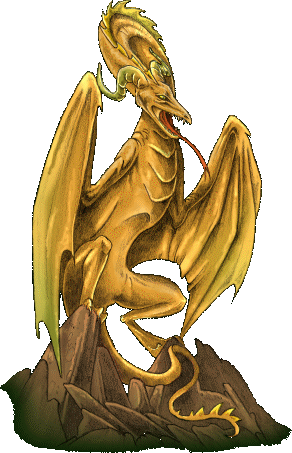
Basic Information
Titles: Pashnah zarah [1]; "the Golden Heeled"
Type/Species: Sea Serpent
Origin: Sumerian Mythology (Mesopotamia), Zoroastrianism's Avesta, Persia's Shahnameh (The Epic of Kings)
About Gandarewa / Gandareva / Kundrav / Kundraw
Gandareva, Gandarewa, Kundra, and Kundraw are all names related to a mighty dragon, or demon, or monster in Ancient Sumeria, Perisa, India, and in the sacred texts of Zoroastrianism. This is why Gandarewa's physical form is not entirely clear, although it is clear that under all his various names he was seen as a powerful, malevolent being.
Gandarewa lived in the sea and was the Indo-Iranian spirit of the deep. [2] His immense size earned him the name Pashnah zarah, for the sea could not go above his heel. He could swallow up twelve people at once, and he did so quite often for his food. [1]
The Avestas describe Gandarewa as a water-dwelling demon that constantly tried to swallow all the good things of creation. His great size and strength made him a terror but not an un-defeatable one. [3]
In India, Gandarewa takes up his home in the sky, his color as bright as a meteor's flame and as beautiful, but sometimes he also resides in the waters, where he spends his time courting the Apsarases, or underwater nymphs of India. [2]
His more famous stories and persona, however, come from Iran, where Gandarewa is seen as the lord of the abyss. [4] He ruled the deep, residing in the in the heavenly sea Vourukasha, the abode of the White Haoma, Gaokerena, or the King of Healing Plants. [2] The White Haoma is a great healing plant that, on rare occasions, Gandarewa gifted to those in need, and because of his previous generosity, he earned the title "Golden Heeled." [4] Unfortunately, Gandarewa spent much of his time jealously guarding this great plant, fiendishly keeping it out of reach of those in need. [2]
Gandarewa was also a spy for Azi Dahaka, and he, too, desired to destroy the good in the world. [4] For his evil, Gandarewa met his end at the hands of Keresaspa (or Karshasp, Kirsap) also known as the Hercules of Iran. Keresaspa had slain other beasts and foe, but Gandarewa's fight proved to be a terrible battle. [1]
Keresaspa traveled to the cosmic sea to slay Gandarewa, who preyed upon people for his meat. Even as he approached, Gandarewa had the bodies of men sticking in his teeth, the victims he preyed upon to fill his belly. [2] In a swift movement, the dragon grabbed Keresaspa's beard, and thus the conflict began. [2]
For nine days and nine nights on end, the battle between Keresaspa and Gandarewa raged in the cosmic ocean. [1] Suddenly, it seemed Keresaspa had the upper hand, having grabbed the mighty Gandarewa by the sole of his foot. Then, the dragon roared in pain as Keresaspa flayed off his skin, straight up to his head, and the hero bound the beast, both hand and foot, to drag him to the seashore. [2,4]
Despite his seeming victory, Gandarewa whipped around, slaughtering fifteen of the hero's horses, eating them to regain his strength. [4] He then threw the now-blinded Keresaspa into a dense thicket, [2] or the scrublands, [5] depending on the version of the story. Gandarewa did not stop there, though. He kidnapped Keresaspa's wife and family out of revenge, pulling them to him in the cosmic ocean. [4]
Although Gandarewa's victory now seemed imminent, Keresaspa picked himself up and returned to the sea, where he released the prisoners. Then, Keresaspa finally dragged the terrible Gandarewa from the bottom of the sea and smashed the beast's head with his club. [1]
Gandarewa once was beneficial and powerful, but he instead spied for Azi Dahaka and jealously guarded the gift he could have shared. The blessings he possessed did not prevent him from evil, and Keresaspa slew him for it. This dragon can be seen as a warning for those who spoil in spite of blessings.
Physical Description
He was a massive creature; while half of him was in the air, the other half would still be in the ocean. His head could rear up and rub the sun, and his heel was taller than the seas. [2]
Related Articles
Footnotes
- Darmesteter The Zend-Avesta
- Carnoy Iranian Mythology
- Lurker 125
- Turner 185
- Rose 131
For more information on footnotes and references, please see the bibliography.