Basic Information
Nickname/Alternative Name/Titles: The Invisible Demon
Type/Species: Sea Serpent
Origin: French Legend (Village of Beaucaire)
About Drac, the Invisible Demon
Drac is a powerful sorcerer-dragon that possessed the power of invisibility. She could terrify people in her draconic form, or she could elude them with her unseen movements. Her particular interest lay in the Lure. She would lure human children for food, and, very rarely, she would lure adults to do her bidding as well.
The most famous captive of Drac was a young village woman. Drac lured her to her cave so that the woman would care for her hatchlings. Once in Drac's clutches, the young woman could not escape. She could not always see Drac or the hatchlings, so any attempt at escape might result in death - not just her own, but that of her entire village. So the woman took care of the brood, and she forgot her own life and her own family for seven years. [1]
One day, however, while the woman rubbed the hatchling dragons, some 'dragon cream' got into her eyes. This cream gave her draconic sight, which enabled her to see the dragons at all times. This is how she knew when the dragons left her unguarded, and she ran away, back to her village, to warn them of Drac's children. Because she could see the dragons, she thought she could help vanquish them all.
But seven years in a den caring for a brood of dragons at her own expense had taken a toll on the woman, who was no longer young or recognizable. The villagers would not listen to her. Unfortunately, Drac caught wind of the situation and quickly put an end to the problem by ripping out the woman's eyes. [1]
During the thirteenth century, Drac lived in the River Rhone. She is attributed the killing of over three thousand knights and villagers, making her one of the most dangerous - and successful - French dragons. The majority of her killings took place outside the small town of Beaucaire, for she reportedly lived very near there. On occasion, however, she would lure or search for other victims outside of the usual range.
One reason for the enormous death count is the dozens of campaigns against her. Many slayers attempted to kill Drac, and sometimes a campaign possess a whole army to attempt to kill her. All of these attempts failed. Specific recorded campaigns to kill Drac (found in early Germanic histories as well as French history) include the following:
- Ocino
- Ragnarold
- Umberto of Guineve
No one slew Drac, and so many believe that she died of old age (or has been rather inactive for many hundreds of years). However, the legacy still lives today, as there is a town named after her - Draguignan. [1]
Physical Description
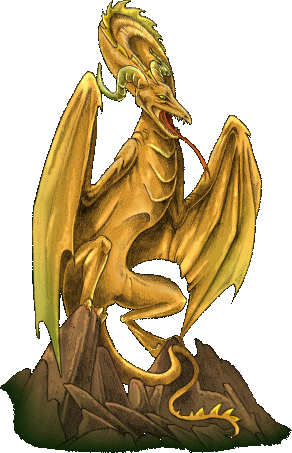
Even though Drac is commonly described as a huge winged sea serpent, her ability to become invisible left few descriptions of her appearance.
Footnotes
For more information on footnotes and references, please see the bibliography.