Introduction
"...alchemy, in itself, is tremendously dark and complex, and the texts very difficult to read, so that an enormous kind of technical background of knowledge is needed if you wish to penetrate into this field."
-- Marie-Louise von Franz [1]
Alchemy combines elements of science, spirituality, mysticism, and philosophy. [4] A helpful, although oversimplified, insight is that alchemy operates on two levels, the physical and the metaphysical. [2] Alchemy deals with spiritual truths, or Mysticism, [5] and in some instances can be defined as "an attempt to demonstrate experimentally on the material plane the validity of a certain philosophical view of the Cosmos." [4]
The alchemical mission had three aspects: the physical, the mental, and the spiritual. [9] This is unlike the modern exploration of science, especially since the early twentieth century, when the divorce between religion and science established itself. [8] The stone of wisdom, or philosopher's stone, represents the physical goal of alchemy, to acquire and to control wealth. [9] For the mental aspect, alchemists sought a universal panacea to cure ills and thereby gain the ability to enjoy life in its entirety. [9] Finally, for the spiritual aspect, the alchemists sought to understand the soul of the world and to enjoy the fruition of spiritual life. [9]
Alchemists worked with little to no codification; that is, each alchemist had personal methodology that only a few others, such as the alchemist's apprentice, experienced directly. This is another reason for the materials being dense.
Specialized Terminology in Alchemy
Below is a handful of expressions or terms specifically used in alchemy.
Coniunctio. A bringing together of opposites that results in the mystical or divine water, the bitter water. [33]
Illud magnum fluxum capitis et caudae. (Latin: Great Flow from Head and Tail) A new light born within the darkness, the illness and weakness disappear into the neurosis that conjured them. [37]
Felix culpa. A double attitude towards the same object or subject; perceiving something as both the illness and the cure. [29]
Prima materia. The original, mysterious substance of the world in which lies God's secret of life and death. [32]
Alchemical Symbolism and Allegory
Allegory is a device that uses characters or events to represent ideas and concepts. In literature, allegory is also referred to as an extended metaphor; however, all forms of art utilize allegory. In Alchemy, allegories were multipurpose: to obfuscate, to reveal, to eclipse the truth, and to illuminate the truth.
Obfuscation prevents individuals from deciphering meaning from alchemical texts, so only those who dedicated themselves to studying the work would be able to understand. [2] In some instances, mistrust inspired the tendency toward obscurity, since some alchemists feared their work would be stolen or misused. However, alchemists did not mystify their work just to hide knowledge, for, to the alchemist, knowledge is poisonous or healing. [29] In the wrong context, knowledge taints understanding; conversely, knowledge unseals the doors of perception.
In their everyday use, however, allegories are meant to reveal. They illustrate a larger concept within a context that is more easily grasped. Those with enough knowledge to read alchemical texts would understand more than a simple description of processing certain elements; the text would also reveal a metaphysical truth.
Thus, the symbolic and allegorical nature of alchemy both obfuscates and elucidates; it eclipses the truth and illuminates that same truth.
Allegories describe both physical chemical reactions [2] as well as metaphysical functions. The nature of alchemical language is very highly mystical, [6] representing chemicals with symbols. For example, the dragon represents the mysterious, philosophical quick silver, or Mercury. [11]
Some other examples from alchemy include the allegory of marriage to describe the combination of dual principles, [21] such as combining heated elements with cooled elements. Another example is the chaos of the elements that demand harmonization, [15] which represents the natural desire to order random stimuli. Sourdough is a favorite allegory for the ferment process to raise matter. [18]
Symbols present a mysterious truth; often, they possess multiple meanings. [43] It is important to separate symbols from sign, which represent or indicate tangible ideas or objects. The knowledge of symbolism is a net in which to capture the indescribable mystery an immediate experience. [38]
A symbol attempts to envelop or at least to indicate that which is unspeakable, ineffable. Symbols imply a multiplicity of meaning, which highlights the reason behind the intense usage of them within alchemy. Alchemists possess a love of symbolism, [7] for like allegory, a symbol can both illuminate and eclipse the truth.
The dragon and the serpent are among the symbols used to represent alchemical action. [2] The snake and the tail eater, the Ouroboros, appear in many alchemical manuscripts as well. [34]
The Alchemical Salamander
The salamander, sometimes linked to the dragon in terms of its magical properties, appears in alchemical symbolism. The most common representation is the image of the salamander, representing prima materia, roasting in the fire. [35] This represents the emotional reactions, especially frustration, involved in withdrawing personal projections and expectations in an effort to understand natural phenomenon.
The Alchemical Caduceus
The caduceus, as Mercury's staff, had two serpents fixed around it, demonstrating Mercury's power and ability to transform his shape. [20] The Caduceus, as a symbol, consists of two serpents entwined around a staff, representing Hermes (Greek) or Mercury (Roman). [2]
The Greek Caduceus sometimes was depicted with wings, which represented the volatility of Mercury. [2] Alchemists referred to mercury as chaotic water or the Philosophical Basilisk. [2]
The Alchemical Serpent
Serpents often represent the impersonal nature of the unconscious as it bursts into consciousness, especially in mythology and dreaming. [40] When the act of the coniunctio, the bringing together of opposites, occurs, the serpent is frequently part of the symbolism. This is especially true when representing androgyny, i.e. an image of the union of king and queen as a single androgynous god might also have both holding a serpent. [39]
Serpents represent everything from the monstrous snake to the cosmic serpent. The cosmic spirit, the supreme serpent, brings everything to life but also kills everything. [19] The cosmic serpent is everything and nothing at the same time. [19]
The monstrous serpent is an impediment, a danger. When a person hides in false shelter or a prison, violence and fire is needed to escape the danger of the diabolical serpent. [25] In times of spiritual or emotional turmoil, a person can become bound to this monstrous serpent [23]; to break that bond, the individual may fight or may simply endure the fire till it burns itself out. [42]
The Alchemical Ouroboros
"Therefore, there are such sayings as, 'Take the head, but beware of the tail,' or 'Unless the head has integrated the tail, the whole substance is nothing.'"
-- Marie-Louise von Franz [34]
The Ouroboros is an ancient symbol, depicted on ancient Egyptian tombs, such as Sethi the First, [30] because, to the Egyptians, the snake that eats is own tail is considered the guardian of the underworld. [31]
In alchemy, the Ouroboros is the Mercurial tail-eater [22] or the encircled serpent. In Coptic, ouro means 'king,' and in Hebrew ob means 'serpent.' [19] Its end is also its beginning, endlessly eating its own tail. [2] The Ouroboros symbolizes the circular, self-contained process of alchemical work. [28]
Many processes use the serpent as a symbol of sublimation or fertilization. Like the dragon, the serpent can represent the philosophical mercury, too. The sublimation or fertilization continues in some processes until "the serpent has swallowed its own tail" and the chemical process ends where it began. [13]
Another understanding of this process is that the Ouroboros is where opposites are one. The head and tail, usually opposites, meet, and there a flow is born, "which is what the alchemists mean by the mystical or divine water... the meaningful flux of life." [37] This particular symbolism hints at another truth, that the two opposites are secretly one and the same because fire is put out by fire or must be cooled by its own inner fire. [41] "In alchemy the mercurial serpent devours itself in fire water, just as destructive emotion has to burn itself out." [42]
The Alchemical Dragon
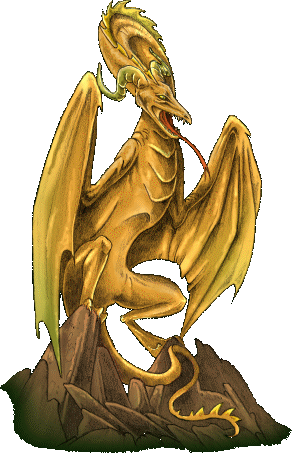
The alchemical dragon represents the philosophical quick silver; [11] unlike ordinary Mercury, the philosophical quick silver is a mysterious substance of unknown origin. [10] From this quick silver, the living spirit can be extracted. [12] While the dragon does not represent this living spirit, it is the vessel in which the spirit is contained.
Some alchemical texts mention a process to identify the spirit, or the soul, of all things. The dragon is prepared from the philosopher's venom. [17] The Mercurius fires up the primordial dragon, giving it wings. [14] In a physical sense, this is the process of vaporization. The universal spirit is the blood of that dragon. [14]
The dragon, as a fabulous winged being, symbolizes philosophical renewal, or the initial pulverizations. [16] In other instances, the image of a dragon or wyvern represents the divine mercurial water and its tincturing power. [24]
Slaying the Alchemical Dragon
Only the act of or the product of coniunctio, the coming together of opposites, can slay the alchemical dragon, commonly written as the Mercurial dragon. [26]
The dragon slayer Cadmus embodies the fixing properties of sulfur. [27] Both the moisture and the sulfur must be removed to stop the process represented by the dragon.
Footnotes
- Franz 13
- Dragons and Serpents of Alchemy - The Dragon Stone. Link defunct. <http://www.polenth.com/myth/alchemy.html>
- Introduction to Alchemy
- Redgrove 1
- Redgrove 2
- Redgrove 5
- Redgrove 6
- Redgrove 7
- Redgrove 10
- Roob 38
- Roob 39
- Roob 44
- Roob 51
- Roob 58
- Roob 68
- Roob 73
- Roob 74
- Roob 128
- Roob 129
- Roob 130
- Roob 131
- Roob 132
- Roob 133
- Roob 134
- Roob 135
- Roob 136
- Roob 183
- Franz 41
- Franz 55
- Franz 69
- Franz 70
- Franz 84
- Franz 90
- Franz 116
- Franz 117
- Franz 171
- Franz 174
- Franz 192
- Franz 201
- Franz 243
- Franz 251
- Franz 253
- Origins: Culture: Sign Vs Symbol
For more information on footnotes and references, please see the bibliography.